


Disclosure: Some links in this Jean Phil Effect review are affiliate links. If you buy through them, I may earn a commission at no extra cost to you. I only write about products I’d be comfortable recommending to my own list, and I’ll tell you where I think this one falls short.
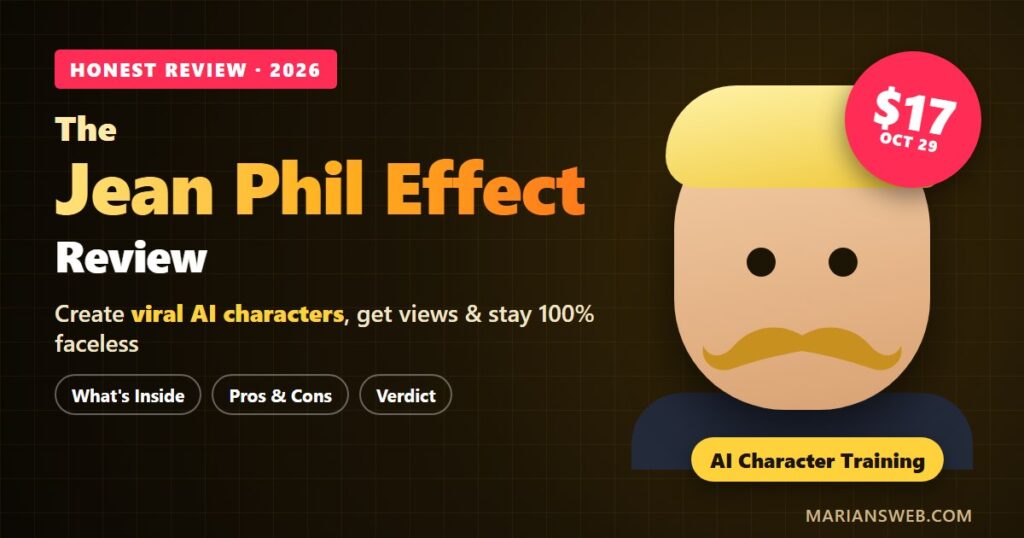
Have you seen the blonde guy with the curled moustache, in a suit, throwing punches in a park?
That’s Jean Phil. He isn’t real. He’s an AI character, and according to the creators of this training, his first eight videos pulled in more than 77 million views in under two weeks, starting from zero followers. The person behind him never showed their face.
James Renouf and Max Gerstenmeyer saw that, started building their own weird AI characters, and turned what they learned into a $17 training called The Jean Phil Effect. In this Jean Phil Effect review I’ll cover what’s inside, how the method works, what it costs, who it’s for, and the things you should know before you buy.
The Jean Phil Effect Review: Quick Summary
- Product: The Jean Phil Effect (step-by-step video training)
- Creators: James Renouf & Max Gerstenmeyer
- Launch: October 29, 2026 at 10 AM Eastern on JVZoo
- Price: $17
- What it teaches: How to create your own bizarre AI characters, put them into trending video formats, grow faceless accounts, and monetize the views
- Camera needed: No. You stay 100% anonymous
- Paid tools needed: No. The training shows a free tool option
- Guarantee: 30-day money-back guarantee
- My verdict: A cheap, timely way to get into the AI character trend early. Worth $17 if you’ll actually create and post for a few weeks
What Is The Jean Phil Effect?
The Jean Phil Effect is a beginner training (not software) that shows you how to create your own AI character and build a faceless video channel around it.
The idea is simple. Instead of being the face of your content, you invent a memorable character: an odd look, a big personality, a funny situation. Then you put that character into video formats that are already trending, and let the character do the performing.
James and Max say they use an AI tool to spot what’s trending, drop their characters into those formats, and make each video their own. They describe it as close to “copy and paste,” which is a big part of the appeal for beginners.
Watch James and Max Explain It
Here’s the official video from the sales page. It shows the characters and the reasoning behind the training:
Why AI Characters Are Getting So Many Views
This is the most interesting part of the whole story, so it’s worth a minute.
For years the big question online was “Is this AI?” With characters like Jean Phil, the comments turned into a debate. Is he real? Is he not? People argued, and all that arguing is engagement, which pushes the videos to even more people. Eventually viewers landed on: “I don’t care if he’s real, I like the videos.”
That’s the shift. People don’t need to believe a character is a real person to want to see what happens next. And once Jean Phil broke through, a wave of other AI characters followed. The sales page lists several examples with public Instagram and TikTok accounts:
| AI character | Reported views |
|---|---|
| Jean Phil | 77M+ from 8 videos in 13 days (141.5M total across 12 posts) |
| Abu Shalab | 151.5M |
| Derek Mercer | 87M |
| Benjamin Stachio | 65.5M from 10 videos |
| Mia Zelu | 18.9M |
| Milton Bumford | Close to 10M |
One thing to keep in mind: those are other people’s characters, used as proof that the trend is real. James and Max say their own characters have reached “thousands of views” so far. That’s honest, and it’s a more realistic picture of where a new creator starts.
What’s Inside The Jean Phil Effect?
Based on the sales page, the training covers four main areas:
1. Create your own AI character in minutes
Step-by-step instructions for turning an idea into a consistent AI character, so you’re building something of your own instead of collecting other people’s clips.
2. Make character-led videos without filming yourself
Your character appears on screen, not you. No camera, no showing your family, no personal content.
3. Use a specific free tool to get started
James and Max say they spent thousands testing dozens of AI platforms before realising they didn’t need to pay for anything. The training shows you what to use and what to avoid, so you can start for free and only pay for tools later if you want to.
4. Attract attention and monetize it
Views alone don’t pay the bills, so the training also covers several ways to earn from the traffic:
- Platform payouts from the views themselves (once your account qualifies for each platform’s creator program)
- Posting the same video on multiple platforms to earn from more than one site
- Sending traffic to offers, such as affiliate products
- A couple of extra “secret sources” they share inside
How the Jean Phil Effect Method Works (In 4 Steps)
- Create your character. Give them a strong look and personality people will remember.
- Find what’s trending. Use AI to spot video formats that are already taking off.
- Put your character in the trend. Rebuild the format with your character and make it your own.
- Post, grow, and monetize. Share across platforms, then turn the attention into income.
It’s the same “start from what’s already working” idea I liked in my ViralForge review. The difference is that The Jean Phil Effect is a $17 training on a method, while ViralForge is software that automates the video making.
Who Is The Jean Phil Effect For?
- Beginners who want to try faceless content without spending much
- People who don’t want to be on camera or share their personal life online
- Affiliate marketers looking for a new source of free social traffic
- Creative people who already have a funny character idea in their head
Who should skip it?
- Anyone expecting a push-button app. This is training; you still make and post the videos
- People who want guaranteed income fast. Viral results like Jean Phil’s are the exception
- Experienced AI video creators who already run character accounts
The Jean Phil Effect Pros and Cons
✅ Pros
- Very low price at $17
- Early on a trend that’s clearly getting huge views
- Completely faceless and anonymous
- Can be done with free tools
- Covers monetization, not just making videos
- Beginner-friendly, no tech skills needed
- 30-day money-back guarantee
❌ Cons
- The big view numbers come from other creators’ accounts
- Free AI tools can change their limits or pricing at any time
- Platform payouts need you to qualify first
- Trends move fast, so you need to act soon
- Results depend on your consistency and creativity
Things to Know Before You Start
A few tips from me, whatever course you use for AI character content:
- Label your AI content. TikTok, Instagram and YouTube all have rules about AI-generated videos. Turning on the AI label keeps your account safe, and as Jean Phil shows, it doesn’t stop people watching.
- Make it yours. Use trending formats as inspiration, but don’t reupload other people’s footage. Your character is the original part.
- Be careful with crypto. The sales page mentions that Jean Phil promoted a cryptocurrency. Creators themselves say you don’t have to go that route, and I’d personally stick to platform payouts and offers you trust.
- Give it 30 days. Most accounts don’t take off with the first video. Post regularly, see which ideas get traction, and make more of those.
The Jean Phil Effect Price
The Jean Phil Effect goes live on October 29, 2026 at 10 AM Eastern and is listed at $17. For that you get:
- Step-by-step guidance for creating your own AI characters (including what doesn’t work)
- A character-led content approach that keeps you off camera
- Guidance on attracting attention with that content
- Multiple approaches to monetizing the attention
- Options that use free tools
The main training is covered by a 30-day money-back guarantee. If you’re not happy for any reason, you can ask for a full refund within 30 days. Like most JVZoo launches, you may be shown optional upgrades after checkout. You don’t need them to follow the main training.
The Jean Phil Effect Review FAQ
Who is Jean Phil?
Jean Phil (short for “Jean Philanthrope”) is an AI-generated character (a blonde man with a curled moustache, in a suit) who first appeared on September 17, 2026 and went viral within days. The creator behind him has stayed anonymous.
Do I have to be on camera?
No. You never show your face or film yourself. Your AI character is the one on screen.
Do I need paid AI subscriptions?
No. The training includes options that use specific free tools. You can decide later if you want to pay for anything.
Am I copying Jean Phil?
No. You create your own characters. Jean Phil is the case study that inspired the training, not a character you get the rights to use.
I’ve never made an AI character. Can I do this?
Yes. The process is shown step by step, and no technical experience is needed.
When does The Jean Phil Effect launch?
The cart opens on October 29, 2026 at 10 AM Eastern on JVZoo. If you click before then, you’ll land on the sales page and can buy as soon as it goes live.
Is there a refund policy?
Yes. The main training has a 30-day money-back guarantee.
Final Verdict: Is The Jean Phil Effect Worth It?
Every few years a new kind of content shows up and the people who jump in early get the easy views. Right now, weird AI characters look like one of those moments. The numbers on accounts like Jean Phil, Derek Mercer and Abu Shalab are hard to ignore.
The Jean Phil Effect won’t make anything go viral for you. You still have to create and post. But for $17, with free tools and a 30-day guarantee, it’s a low-risk way to learn a faceless method while the trend is still young, from two guys who are doing it themselves right now.
My rating: 4.3 / 5, recommended for beginners who want a cheap, camera-free way into short-form video.
Looking at other ways to make money with AI? Check out my list of the top AI tools that help you make money online.
Earnings disclaimer: The Jean Phil Effect does not guarantee income or success. View counts mentioned in this review come from the product’s sales page and refer to accounts not run by the course creators. They are not typical and don’t predict what you will achieve. Your results depend on your effort, creativity, consistency, the platforms and other factors.