
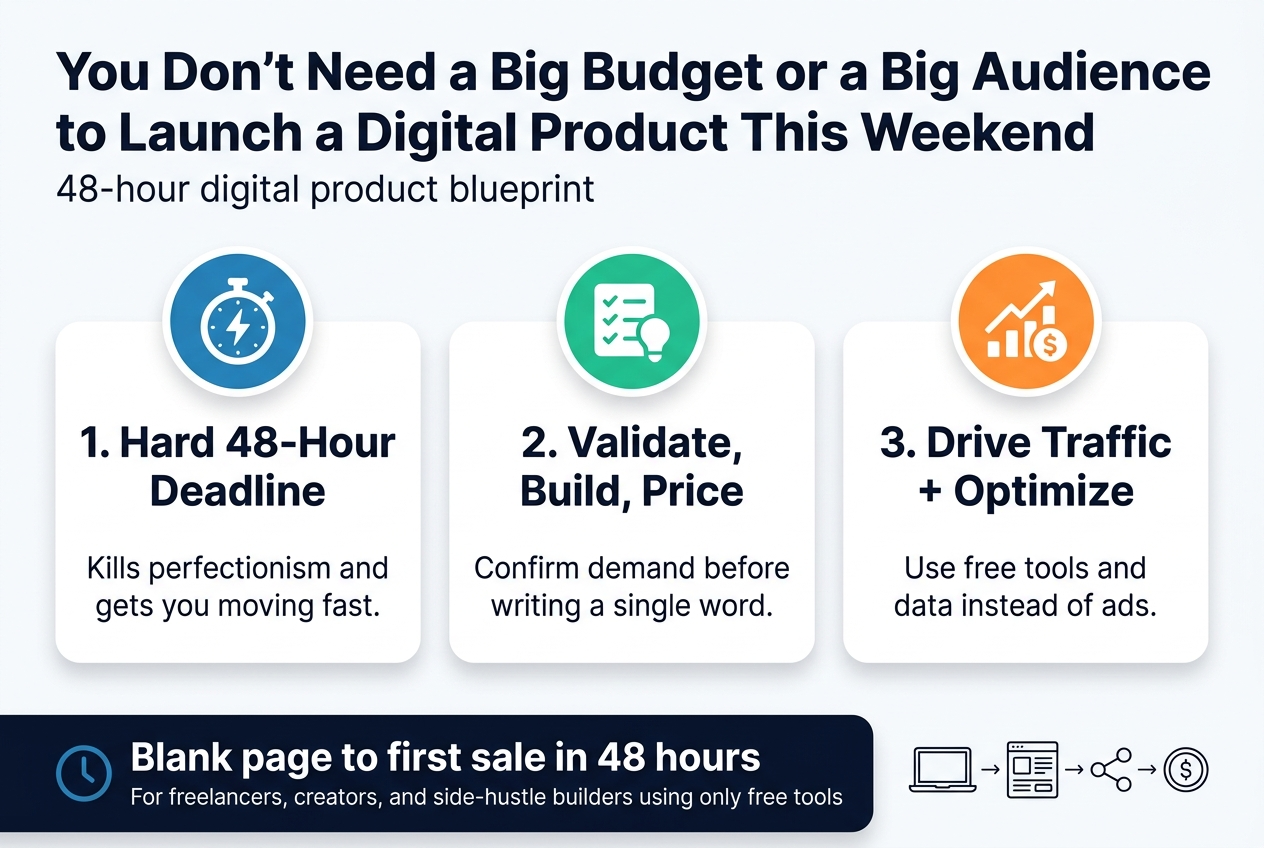
You Don’t Need a Big Budget or a Big Audience to Launch a Digital Product This Weekend
If you’ve been sitting on a product idea for months — tweaking, researching, waiting until it feels “ready” — this guide is for you. Specifically, it’s for freelancers, creators, and side-hustle builders who have real skills and zero dollars to spend, but want to turn what they know into something people will actually pay for.
The 48-hour digital product blueprint is a hour-by-hour plan that takes you from blank page to first sale using only free tools. No paid ads. No expensive software. No excuses left by Sunday night.
Here’s what you’ll walk away knowing:
- Why a hard 48-hour deadline is actually your best friend — and how it kills the perfectionism loop that keeps most creators stuck
- How to validate, build, and price your product before you write a single word — so you’re not building something nobody wants
- How to drive real traffic and optimize your conversions using data — without spending a dollar on ads
If you’ve watched other people sell digital products online while you keep “getting ready,” that gap is costing you real money every month. Let’s close it.
Why the 48-Hour Deadline Is Your Most Powerful Tool
How a Hard Deadline Kills Perfectionism and Forces Action
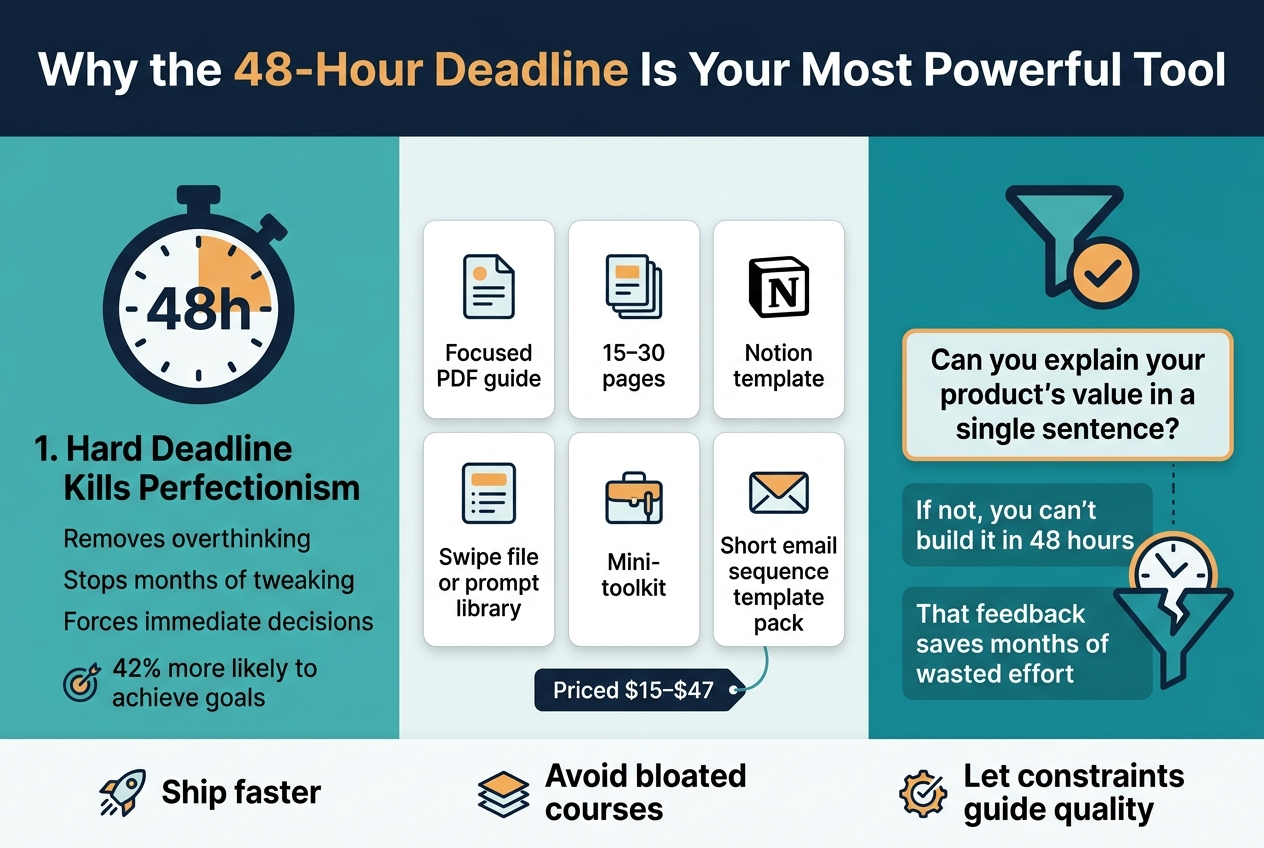
A 48-hour deadline removes your ability to overthink. Without a fixed endpoint, you’ll spend months tweaking, waiting, and never shipping. Research shows people who set goals with specific deadlines are 42% more likely to achieve them. Your hard deadline eliminates endless A/B testing and forces immediate decisions instead.
What You Can Realistically Build and Sell in 48 Hours
Within 48 hours, you can build products that sell daily, including:
- A focused PDF guide (15–30 pages)
- A Notion template with genuine utility
- A swipe file or prompt library
- A mini-toolkit
- A short email sequence template pack
Priced between $15–$47, these products generate first sales faster than bloated, expensive courses ever could.
Why Tight Constraints Filter Weak Ideas Before You Waste Time
With this in mind, the 48-hour rule acts as your earliest quality filter. Ask yourself one question: Can you explain your product’s value in a single sentence?
If you can’t, you can’t build it in 48 hours — and that’s valuable feedback before you waste your time. Tight constraints expose weak ideas immediately, saving you from months of wasted effort.
Hours 0-4: Validate Your Idea Before Writing a Single Word
Where to Find Real, Painful Problems People Will Pay to Solve
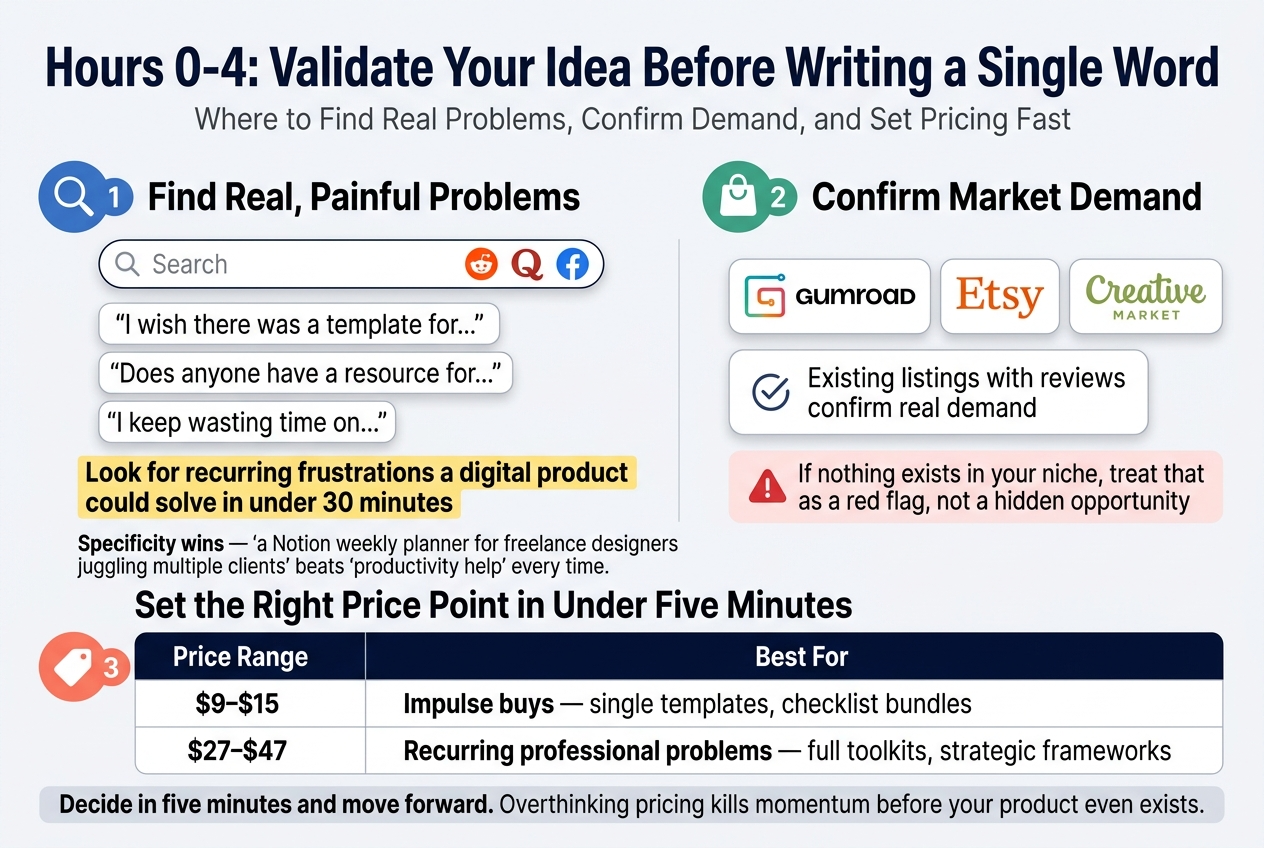
Search Reddit, Quora, or niche Facebook groups using phrases like:
- “I wish there was a template for…”
- “Does anyone have a resource for…”
- “I keep wasting time on…”
Look for recurring frustrations a digital product could solve in under 30 minutes for your buyer. Specificity wins — “a Notion weekly planner for freelance designers juggling multiple clients” beats “productivity help” every time.
How to Confirm Market Demand Using Gumroad, Etsy, and Reddit
With this in mind, search Gumroad, Etsy, or Creative Market for similar products. Existing listings with reviews confirm real demand. If nothing exists in your niche, treat that as a red flag, not a hidden opportunity.
How to Set the Right Price Point in Under Five Minutes
Now that you’ve confirmed demand, lock in your price using this simple framework:
| Price Range | Best For |
|---|---|
| $9–$15 | Impulse buys — single templates, checklist bundles |
| $27–$47 | Recurring professional problems — full toolkits, strategic frameworks |
Decide in five minutes and move forward. Overthinking pricing kills momentum before your product even exists.
Hours 4-20: Build a Sellable Product Using Only Free Tools
The Complete Zero-Cost Tech Stack That Professional Creators Use
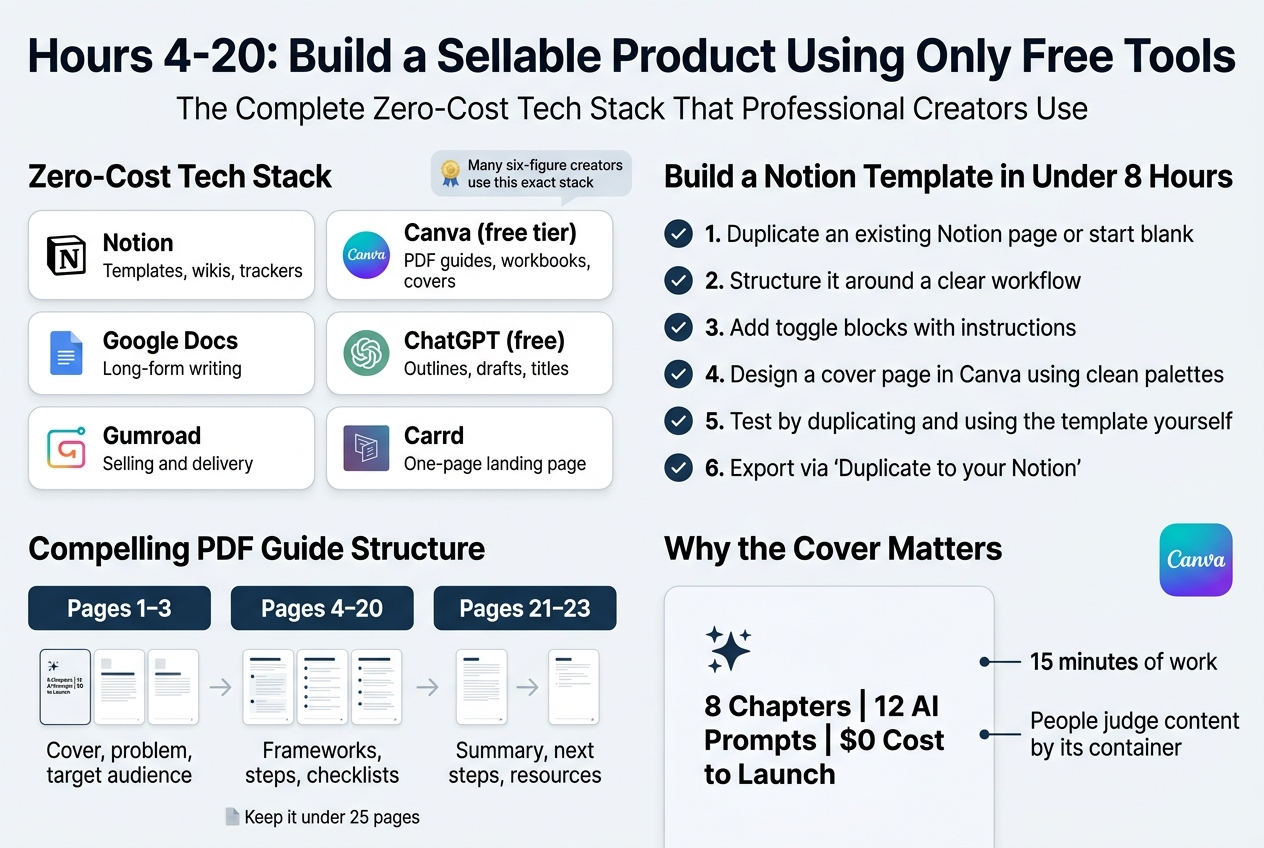
Your entire product business runs on these free tools:
| Tool | Purpose |
|---|---|
| Notion | Templates, wikis, trackers |
| Canva (free tier) | PDF guides, workbooks, covers |
| Google Docs | Long-form writing |
| ChatGPT (free) | Outlines, drafts, titles |
| Gumroad | Selling and delivery |
| Carrd | One-page landing page |
Many six-figure creators still use this exact stack. Upgrade your idea, not your tools.
Step-by-Step Process to Build a High-Value Notion Template in Under 8 Hours
- Duplicate an existing Notion page or start blank
- Structure it around a clear workflow (first, second, third steps)
- Add toggle blocks with instructions
- Design a cover page in Canva using clean palettes
- Test by duplicating and using the template yourself
- Export via “Duplicate to your Notion”
How to Structure a Compelling PDF Guide That Buyers Actually Read
Keep your guide under 25 pages using Canva’s document templates:
- Pages 1–3: Cover, problem, target audience
- Pages 4–20: Frameworks, steps, checklists
- Pages 21–23: Summary, next steps, resources
Write short paragraphs, use headers, and include one visual per major section.
Why a Professional Cover Image Transforms How Buyers Perceive Your Product
Your cover is your highest-ROI investment — just 15 minutes of work. PDFs without covers look like homework. A branded cover with a clear title and stats bar like “8 Chapters | 12 AI Prompts | $0 Cost to Launch” instantly signals value. People judge content by its container. Use Canva’s free ebook cover templates to get started.
Hours 20-28: Build a Landing Page That Converts Without Spending a Dollar
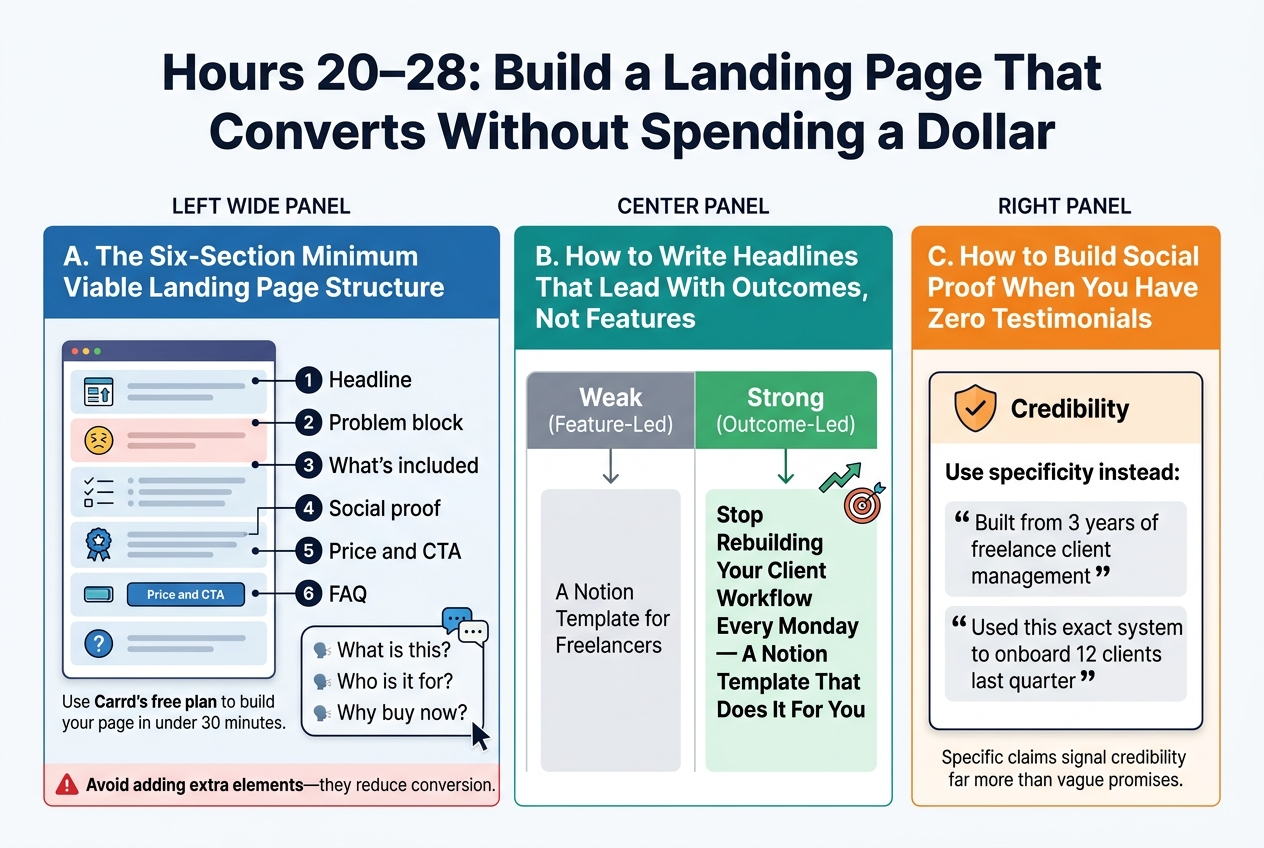
A. The Six-Section Minimum Viable Landing Page Structure
Use Carrd’s free plan to build your page in under 30 minutes. Your landing page must answer three questions: What is this? Who is it for? Why buy now? Structure it with exactly these six sections:
- Headline – Lead with the outcome
- Problem block – Mirror your buyer’s frustration
- What’s included – Specific deliverables in bullet form
- Social proof – Build credibility without testimonials
- Price and CTA – Single button linking to Gumroad
- FAQ – Address your top three objections
Avoid adding extra elements—they reduce conversion.
B. How to Write Headlines That Lead With Outcomes, Not Features
Your headline should sell the result, not the product. Compare these two approaches:
| Weak (Feature-Led) | Strong (Outcome-Led) |
|---|---|
| “A Notion Template for Freelancers” | “Stop Rebuilding Your Client Workflow Every Monday — A Notion Template That Does It For You” |
C. How to Build Social Proof When You Have Zero Testimonials
With this in mind, you don’t need customer reviews to establish trust. Use specificity instead:
- “Built from 3 years of freelance client management”
- “Used this exact system to onboard 12 clients last quarter”
Specific claims signal credibility far more than vague promises.
Hours 28-36: Drive Traffic and Sales With Zero Ad Budget
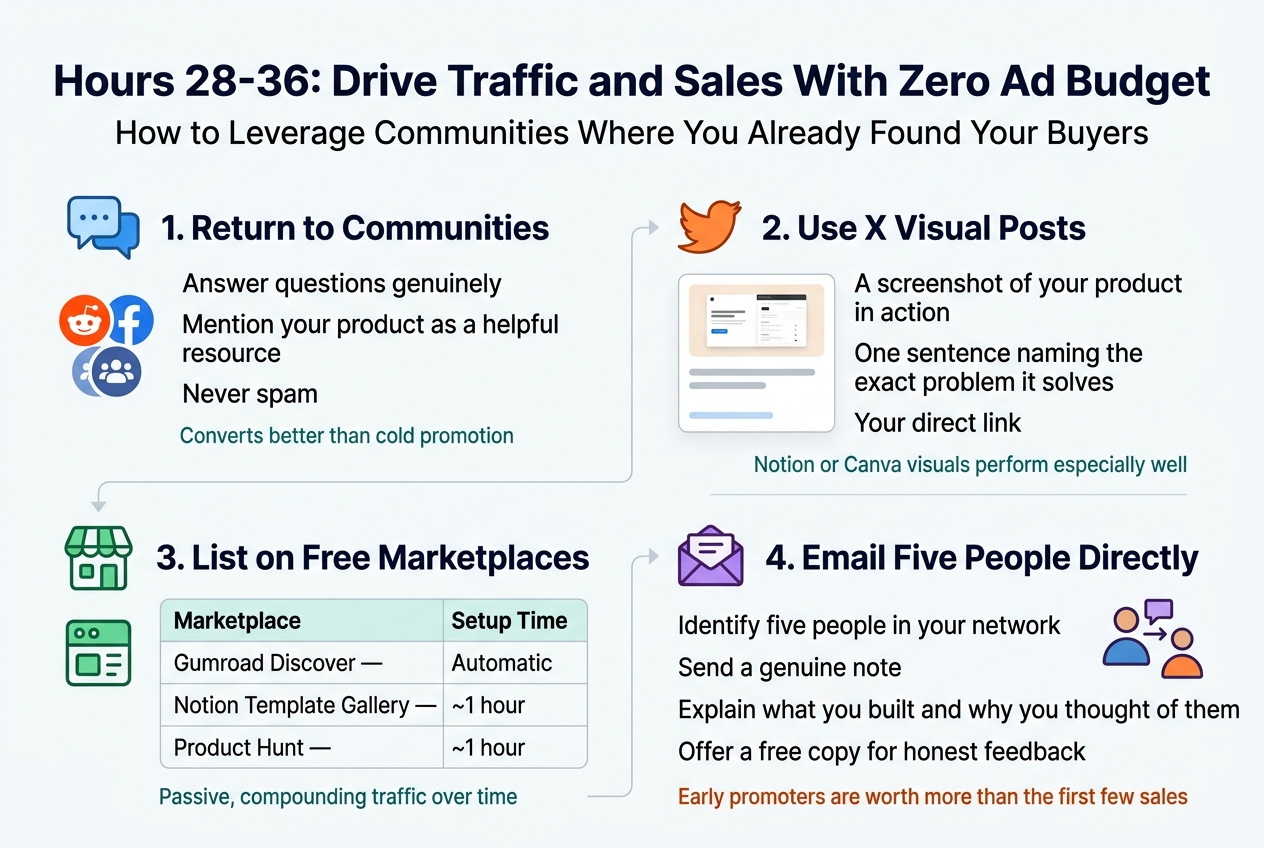
How to Leverage Communities Where You Already Found Your Buyers
Return to the Reddit threads and Facebook groups where you validated your idea. Answer questions genuinely, then mention your product as a helpful resource — never spam. This contextual approach converts far better than cold promotion.
How to Use X (Twitter) Visual Posts to Generate Immediate Clicks
Visual posts consistently outperform plain text on X. Combine:
- A screenshot of your product in action
- One sentence naming the exact problem it solves
- Your direct link
Visuals created in Notion or Canva perform especially well and require zero design budget.
Free Marketplaces That Create Passive, Compounding Traffic Over Time
With this in mind, list your product on platforms that generate ongoing discovery:
| Marketplace | Setup Time |
|---|---|
| Gumroad Discover | Automatic |
| Notion Template Gallery | ~1 hour |
| Product Hunt | ~1 hour |
These listings work passively long after your 48-hour sprint ends.
Why Emailing Five People Directly Outperforms a Broadcast Launch
Now that we’ve covered passive channels, go personal. Identify five people in your network who match your ideal buyer. Send each a genuine note explaining what you built and why you thought of them. Offer a free copy for honest feedback — early promoters are worth more than the first few sales.
Hours 36-44: Use Real Data to Optimize Conversions Fast
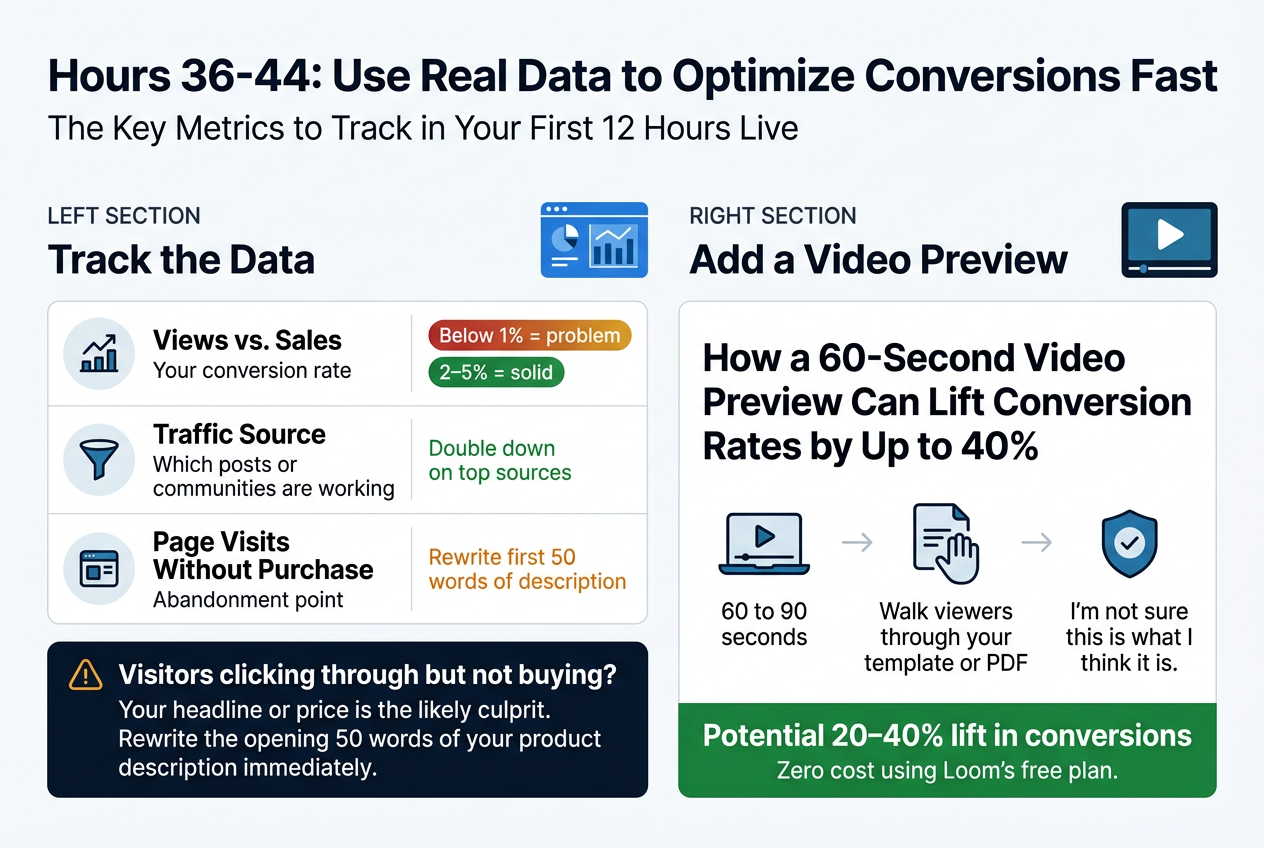
The Key Metrics to Track in Your First 12 Hours Live
Now that your landing page is live, your first job is reading the data — not guessing. Use Gumroad’s built-in analytics to monitor these critical signals:
| Metric | What It Tells You | Benchmark |
|---|---|---|
| Views vs. Sales | Your conversion rate | Below 1% = problem; 2–5% = solid |
| Traffic Source | Which posts or communities are working | Double down on top sources |
| Page Visits Without Purchase | Abandonment point | Rewrite first 50 words of description |
If visitors are clicking through but not buying, your headline or price is the likely culprit. Rewrite the opening 50 words of your product description immediately to address that friction.
How a 60-Second Video Preview Can Lift Conversion Rates by Up to 40%
With this in mind, one of the highest-leverage moves you can make is adding a short video preview — just 60 to 90 seconds — directly to your Gumroad page. Walk viewers through your template or PDF so they know exactly what they’re getting.
This eliminates the most common buyer objection: “I’m not sure this is what I think it is.” The result? A potential 20–40% lift in conversions, at zero cost using Loom’s free plan.
Hours 44-48: Build the Foundation for Long-Term Digital Product Income
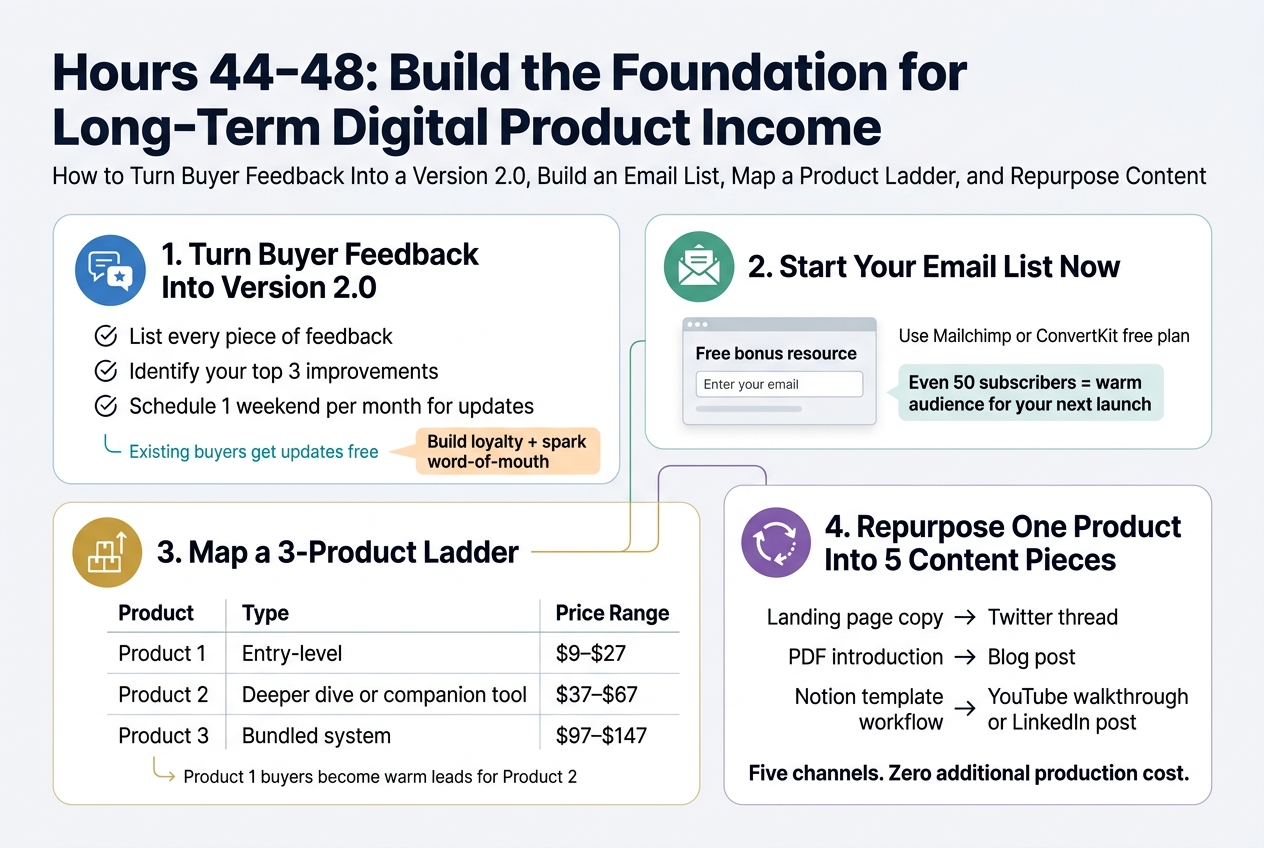
How to Turn Buyer Feedback Into a Version 2.0 That Drives Word-of-Mouth
List every piece of feedback you’ve received and identify your top three improvements. Schedule one weekend per month to release updates — existing buyers get them free, which builds loyalty and sparks word-of-mouth naturally.
Why Starting Your Email List Now Gives Your Next Launch a Head Start
Add a free opt-in to your landing page immediately, offering a one-page bonus resource in exchange for an email address. Use Mailchimp or ConvertKit’s free plan — even 50 subscribers means your next launch already has a warm audience waiting.
How to Map a Three-Product Ladder That Turns a Side Project Into a Business
With this in mind, plan your product ladder strategically:
| Product | Type | Price Range |
|---|---|---|
| Product 1 | Entry-level | $9–$27 |
| Product 2 | Deeper dive or companion tool | $37–$67 |
| Product 3 | Bundled system | $97–$147 |
Buyers of Product 1 become warm leads for Product 2, building a sustainable income stream.
How to Repurpose One Product Into Five Pieces of Content Across Multiple Channels
- Landing page copy → Twitter thread
- PDF introduction → Blog post
- Notion template workflow → YouTube walkthrough or LinkedIn post
Five channels. Zero additional production cost.
The Mindset Shift That Separates Creators Who Earn From Those Who Wait
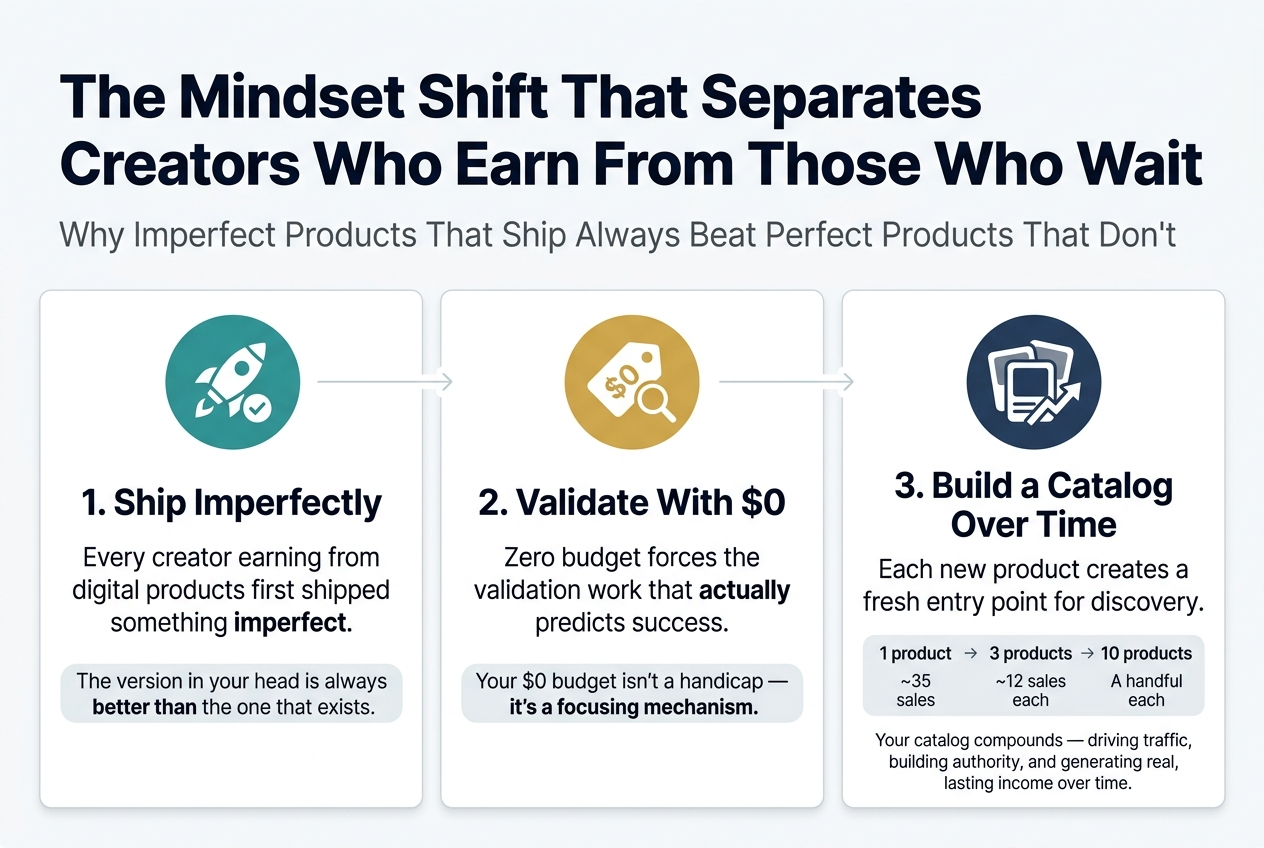
Why Imperfect Products That Ship Always Beat Perfect Products That Don’t
Every creator earning from digital products first shipped something imperfect — a Notion template that started as a personal tracker, a PDF guide with an early typo. The version in your head is always better than the one that exists, but only the existing version can make a sale.
How a Zero-Budget Constraint Forces the Validation Work That Actually Predicts Success
Your $0 budget isn’t a handicap — it’s a focusing mechanism. Without money to spend on tools and ads, you’re forced to validate whether people actually want your product. This essential work is what funded launches often skip, which is why zero-budget launches frequently outperform them in early stages.
The Compound Math Behind Building a Catalog of Digital Products Over Time
Now that we’ve covered validation and shipping, consider what happens when you stack products over time:
| Products in Catalog | Sales Needed Each (to hit $1,000/month at $29) |
|---|---|
| 1 product | ~35 sales |
| 3 products | ~12 sales each |
| 10 products | A handful each |
Each new product creates a fresh entry point for discovery. With this in mind, your catalog compounds — driving traffic, building authority, and generating real, lasting income over time.
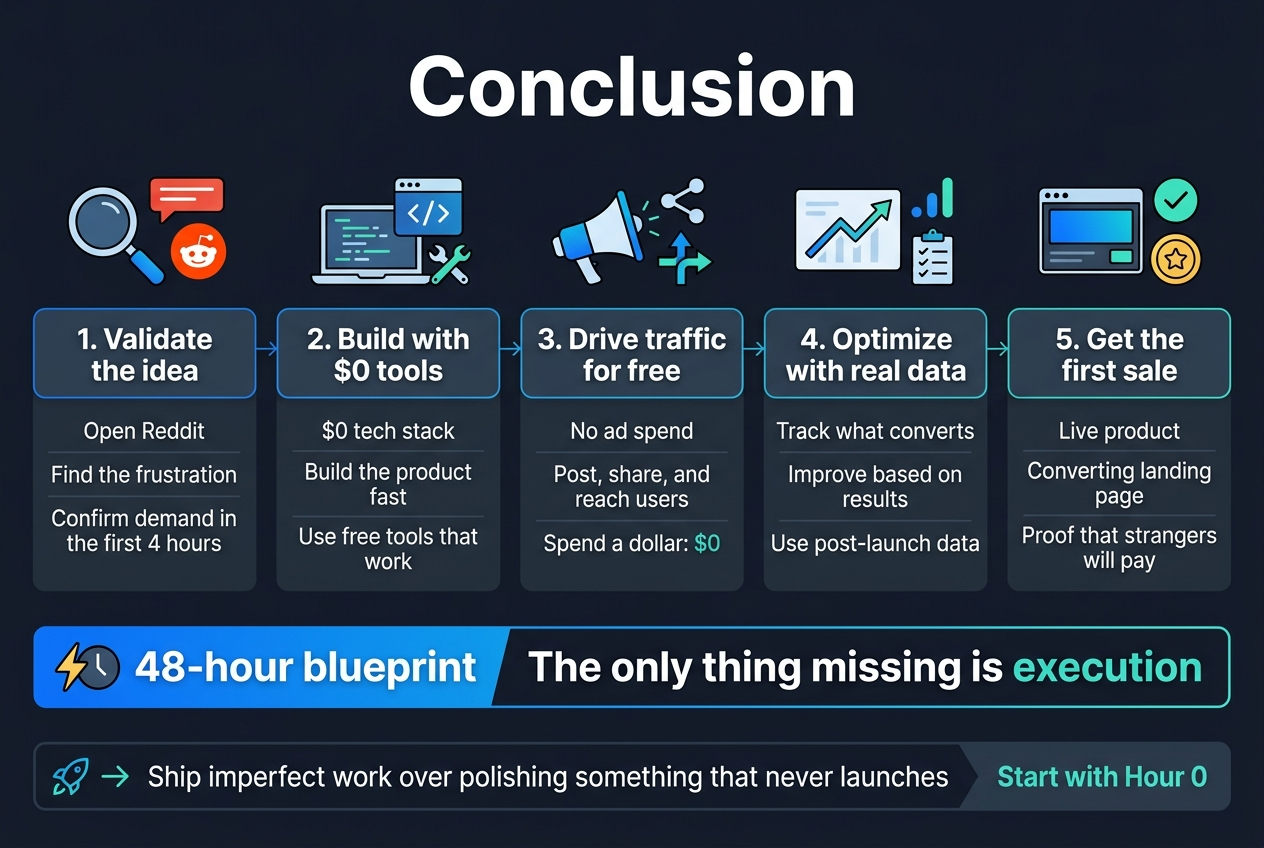
The 48-hour blueprint you just walked through isn’t theoretical. Every phase — from validating your idea in the first four hours, to building your product with free tools, to driving traffic without spending a dollar, to optimizing with real data — is a proven sequence that removes every excuse standing between you and your first sale. You now have a complete hour-by-hour plan, a $0 tech stack that works, and a post-launch foundation designed to grow into a real product ladder. The only thing missing is execution.
The mindset shift that separates creators who earn from those who wait comes down to one decision: shipping imperfect work over polishing something that never launches. Your first product doesn’t need to be perfect. It needs to exist. Start with Hour 0 — open Reddit, find the frustration, validate the demand, and build the thing. Forty-eight hours from now, you could have a live product, a converting landing page, and proof that strangers will pay for what you know. That proof changes everything that comes after it.