

The online course business has changed. A few years ago you could record a set of videos, upload them to a course platform and sell them for months. Today AI chatbots and free YouTube tutorials answer most “how do I…” questions instantly, so plain information is harder to sell. People still pay for courses, but what they pay for now is a result, support and community.
This article explains why traditional video-only courses struggle, what learners actually want in 2026, and a simple model for building a course business that AI can’t replace.
Why Video-Only Courses Are Struggling
| Old model | Why it’s harder now |
|---|---|
| Recorded videos, nothing else | AI tools explain the same concepts for free, on demand |
| One-time purchase, no support | Learners get stuck and quit, so completion and refunds suffer |
| Broad topics (“Marketing Basics”) | Generic information is everywhere |
| No interaction | People want feedback and accountability |
Information isn’t worthless, but on its own it’s no longer enough to justify a high price.
What Learners Pay For Now
- A specific outcome: “Land your first three freelance design clients in 8 weeks”, not “learn design”.
- Experience and shortcuts from someone who has done it, including mistakes to avoid.
- Accountability: deadlines, check-ins and someone who notices when they fall behind.
- Feedback on their actual work.
- Community: peers at the same stage to share wins and questions.
The 3-C Model: Curriculum, Coaching, Community
1. Curriculum built around one result
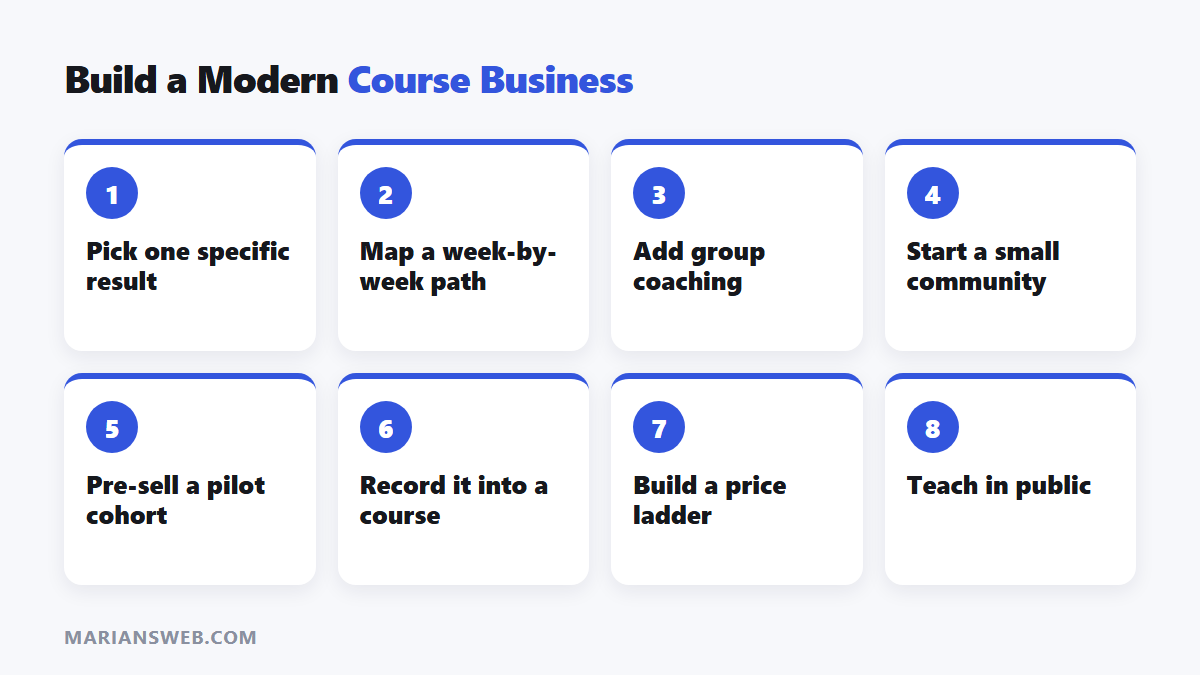
Map the shortest path from where your student is to the result they want, week by week. Each module ends with an action, not just a lesson. Keep videos short and pair them with templates and checklists. AI can help you outline, but the order, examples and shortcuts should come from your experience.
2. Coaching that scales
One-on-one coaching doesn’t scale, but group coaching does. Weekly live Q&A calls, feedback threads, office hours and recorded “hot seats” give each student personal help without you working 60-hour weeks.
3. Community
A private group (Discord, Circle, Skool or a Facebook group) keeps students engaged between calls. Start small and active, with weekly prompts, wins threads and accountability partners.
Validate Before You Build: Run a Pilot Cohort
Don’t record 40 videos before anyone buys. Instead:
- Write a simple page describing the outcome, the length (e.g. six weeks), the live calls and the price.
- Offer a founding-member price to your email list, audience or network.
- Run the first cohort live and create the course materials as you teach.
- Record everything. Those recordings become the course for future cohorts.
This lets you get paid while you build and makes sure you create exactly what students need. My guide to testing a digital income idea without spending money covers more validation methods, and these AI sales copy prompts will help with the sales page.
Pricing a Modern Course
| Offer | Typical price range |
|---|---|
| Self-paced mini course | $27 to $197 |
| Course plus community | $197 to $997 |
| Cohort with live coaching | $500 to $3,000+ |
| Ongoing membership | $29 to $199 per month |
Most course creators do best with a ladder: a low-priced entry product, a core program and a premium coaching option. A small digital product is a great entry point. See the 48-hour digital product blueprint.
Where AI Fits In
- Use AI for: outlines, quiz questions, worksheets, transcripts, summaries and a course-specific AI assistant for students.
- Keep human: the method, the stories, feedback on student work and community leadership.
Courses that combine your expertise with AI tools for students are more valuable, not less. Read AI agents for beginners for ideas on what’s possible.
Marketing Your Course
The best course marketing is teaching in public. Share free lessons on YouTube, short-form video or a blog, collect emails with a free mini-lesson or checklist, and invite your list to each new cohort. If you haven’t built a list yet, start with my free guide The $0 Funnel.
Want help organizing what you know into a course? Get the free “knowledge bank” guide here.
Online Course Business FAQ
Are online courses really dead?
No. Information-only courses are harder to sell, but courses that deliver a clear result with support and community are growing.
Do I need to be an expert?
You need to be a few steps ahead of your students and able to get them a specific result. Being honest about your experience matters more than credentials.
Which platform should I use?
Start simple. Many creators begin with a payment link, a private community and live calls, then move to a course platform once the format is proven.
Your Next Step
Define the one result your course delivers, describe a six-week pilot, and offer it to ten people this month. Your first cohort will teach you more about your online course business than any amount of planning.